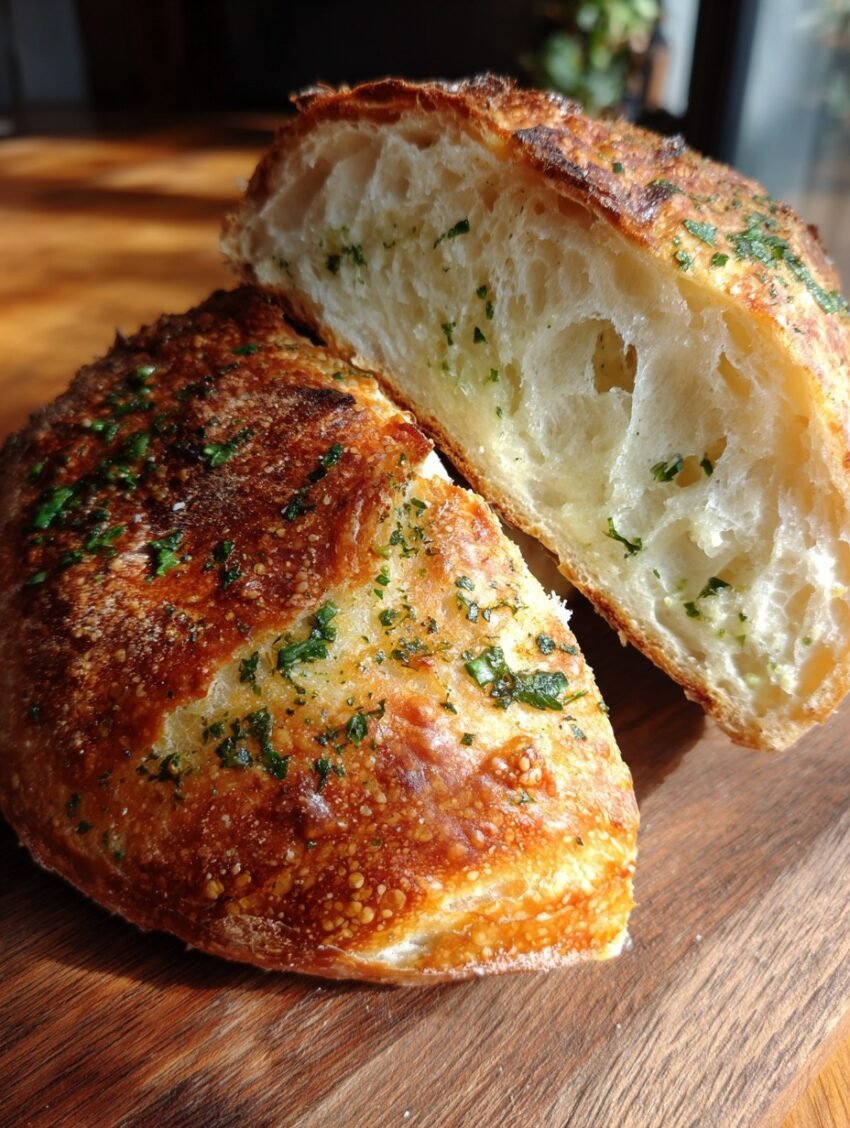
Here’s a recipe for a beautiful, flavorful Rustic Garlic & Herb Sourdough Loaf, complete with a crispy crust and soft, aromatic crumb.
Rustic Garlic & Herb Sourdough Loaf
Yield: 1 large boule (round loaf)
Total Time: ~24 hours (mostly hands-off fermentation)
Active Time: ~30 minutes
Ingredients
For the Leaven (make this 8-12 hours before mixing dough):
-
30g active sourdough starter (100% hydration)
-
60g bread flour
-
60g warm water
For the Main Dough:
-
All of the Leaven (about 150g)
-
450g bread flour (or 400g bread + 50g whole wheat for more flavor)
-
325g warm water (about 80-85°F / 27-29°C)
-
9g fine sea salt (about 1½ tsp)
For the Garlic & Herb Mix-In:
-
4-5 large garlic cloves, finely minced
-
3 tablespoons fresh herbs, finely chopped (a mix of rosemary, thyme, and parsley is ideal)
-
1 tablespoon olive oil
-
Optional: ¼ teaspoon freshly cracked black pepper
For Baking:
-
Rice flour or extra bread flour, for dusting
-
Ice cubes (for steam)
Instructions
Part 1: The Night Before – Make the Leaven
-
Mix the 30g starter, 60g flour, and 60g water in a small jar or bowl until smooth.
-
Cover loosely and let ferment at room temperature for 8-12 hours, until it is bubbly, domed, and at least doubled in size. It should pass the float test (a spoonful floats in water).
Part 2: Mix & Autolyse (Morning)
-
In a large bowl, combine all of the leaven with the 325g warm water. Use your hands or a whisk to dissolve the leaven completely.
-
Add the 450g bread flour and mix until no dry bits remain. The dough will be shaggy. Cover and let rest (autolyse) for 45 minutes.
Part 3: Mix-In & Bulk Fermentation
-
Prepare Herb Mix: While the dough autolyses, combine minced garlic, chopped herbs, olive oil, and pepper in a small bowl. Set aside.
-
Add Salt & Herbs: After the autolyse, sprinkle the 9g salt over the dough. Wet your hand, dimple the salt into the dough, then pour the garlic-herb mixture over top.
-
Use a “pinching and folding” motion to incorporate everything thoroughly for 2-3 minutes.
-
Bulk Ferment: Cover the bowl. Over the next 3-4 hours, perform 4 sets of “stretch and folds,” spaced 30 minutes apart. During the first fold, the dough will be slick and oily; it will become stronger and more cohesive with each fold. After the last fold, let the dough rest, covered, for the remainder of the bulk ferment until it has increased by about 50% and is full of bubbles.
Part 4: Shape & Cold Proof
-
Gently turn the dough out onto a lightly floured surface. Using a bench scraper, shape it into a tight boule (round) by folding the edges to the center and creating surface tension.
-
Place the loaf seam-side up into a banneton or bowl generously dusted with rice flour. Cover with a shower cap or plastic bag.
-
Refrigerate for 12-16 hours (this “cold proof” develops incredible flavor and makes the dough easier to score).
Part 5: Bake (Next Day)
-
Place a Dutch oven (with lid) in your oven and preheat to 500°F (260°C) for at least 45 minutes.
-
Take your dough from the fridge. Place a piece of parchment paper over the banneton, flip it over, and gently lower the dough onto the paper.
-
Score: Using a razor blade or lame, make one confident, deep slash (or a decorative pattern) on top. This controls expansion.
-
Carefully transfer the dough (on the parchment) into the screaming-hot Dutch oven. Add 3-4 ice cubes beside the parchment for extra steam. Cover with the lid.
-
Bake covered at 500°F for 20 minutes.
-
Reduce heat to 450°F (230°C), remove the lid, and bake uncovered for 20-25 minutes more, until the crust is a deep, rustic brown.
-
Cool completely on a wire rack for at least 3 hours before slicing. This allows the crumb to set and flavors to meld.
Baker’s Notes
-
Herb Flexibility: Use what you have! Dried herbs work in a pinch (use 1 tsp each). For a stronger garlic flavor, you can lightly sauté the minced garlic in the oil first.
-
No Dutch Oven? Bake on a preheated pizza stone or steel with a metal pan on the rack below. Pour hot water into the lower pan when you load the bread to create steam.
-
The Float Test: This is the best way to know your leaven is ready. If a spoonful sinks, give it more time.
-
Storage: Keep in a paper bag for 1-2 days for maximum crustiness, then transfer to a plastic bag. It freezes beautifully for up to 3 months.
Enjoy the intoxicating aroma and incredible flavor of your homemade artisan loaf