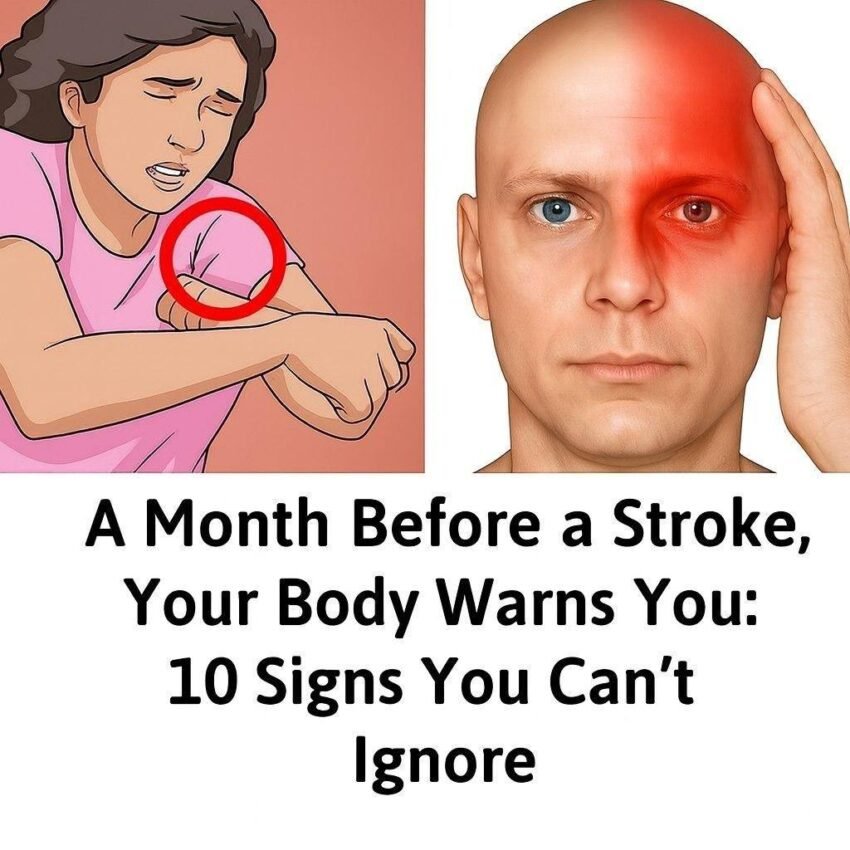
Important Notice: The claim that the body gives specific warnings “a month before a stroke” is not medically accurate. Stroke symptoms typically appear suddenly and require immediate emergency attention.
However, there are subtle, earlier signs of increased stroke risk or mini-strokes (TIAs) that people sometimes overlook. Recognizing these can be life-saving.
Here are 10 signs that may indicate elevated stroke risk or a prior TIA, which should never be ignored.
1. Sudden, Severe Headache (Often Called a “Thunderclap Headache”)
-
Unlike any headache you’ve felt before—extremely intense and peaks within seconds.
-
Can signal a hemorrhagic stroke or aneurysm.
2. Transient Ischemic Attack (TIA) – “Mini-Stroke”
-
Symptoms last only minutes to hours and fully resolve, but they are a major red flag.
-
FAST signs (see below) may occur temporarily: face drooping, arm weakness, speech difficulty.
3. Unexplained Dizziness, Loss of Balance, or Vertigo
-
Feeling suddenly off-balance, dizzy, or uncoordinated without explanation.
4. Brief Memory Lapses or Confusion
-
Sudden confusion, trouble understanding speech, or forgetting familiar things temporarily.
5. Numbness or Weakness on One Side
-
May come and go. Numbness, weakness, or tingling in the face, arm, or leg, especially on one side.
6. Vision Changes (Temporary)
-
Sudden blurred, double, or blackened vision in one or both eyes.
-
A temporary “curtain coming down” over vision.
7. Slurred Speech or Difficulty Speaking
-
Speech becomes slurred, garbled, or hard to understand, even if temporary.
8. Unusual Fatigue or Mental Fog
-
Sudden, unexplained exhaustion or “brain fog” that’s not linked to exertion or lack of sleep.
9. Frequent Hiccups (in some cases, especially in women)
-
Persistent, uncontrollable hiccups can sometimes be linked to strokes affecting the brain stem (more common in posterior circulation strokes).
10. Personality Changes or Mood Swings
-
Unexplained agitation, emotional instability, or personality shifts may rarely occur due to reduced blood flow.
🚨 The FAST Stroke Acronym (ACT IMMEDIATELY)
If you notice any of these, call emergency services immediately:
-
Face drooping
-
Arm weakness
-
Speech difficulty
-
Time to call 911 (or your local emergency number)
Do NOT wait to see if symptoms go away. Every minute counts.
Risk Factors vs. “Warning Signs”
While the above symptoms can be early indicators, true risk factors are more reliable predictors:
-
High blood pressure
-
Atrial fibrillation (irregular heartbeat)
-
Diabetes
-
High cholesterol
-
Smoking
-
Obesity
-
Family history of stroke
-
Previous TIA or stroke
What to Do If You Experience Any of These Signs
-
Do not ignore them, even if they go away.
-
See a doctor promptly for evaluation—request a neurological exam, imaging (CT/MRI), and vascular studies.
-
Manage risk factors: Control blood pressure, cholesterol, blood sugar; quit smoking; maintain a healthy weight and active lifestyle.
-
Know your numbers: Regular check-ups are key.
Bottom line: While the body doesn’t give a “one-month warning,” it can send subtle signals of increased risk or mini-strokes. Any sudden neurological symptom is a medical emergency. Prevention through managing risk factors and rapid response to symptoms are the best ways to protect yourself. Always consult a healthcare provider for personalized guidance.